MJF Vs SLS: How to Choose the Right Powder Bed Tech for Functional Parts
If you’re a mechanical design engineer, you’ve likely moved past the "cool factor" of 3D printing. You aren't just printing desktop trinkets; you’re looking for functional parts that can survive a stress test, fit into a complex assembly, or even go straight into end-use production.
When it comes to functional plastics, the conversation almost always lands on two heavy hitters: Selective Laser Sintering (SLS) and Multi Jet Fusion (MJF).
Both fall under the "Powder Bed Fusion" umbrella. Both skip the need for support structures. Both give you incredible design freedom. But choosing the wrong one can mean the difference between a part that holds up under pressure and one that snaps along a hidden grain.
At SICAM, we see these technologies as tools in a toolkit. Neither is "better" in a vacuum: it’s all about which one is better for your specific application. Let’s break down the differences so you can stop guessing and start building.
The Core Difference: How They’re Made
 To choose the right tech, you have to understand the "how."
SLS (Selective Laser Sintering) is the seasoned veteran.
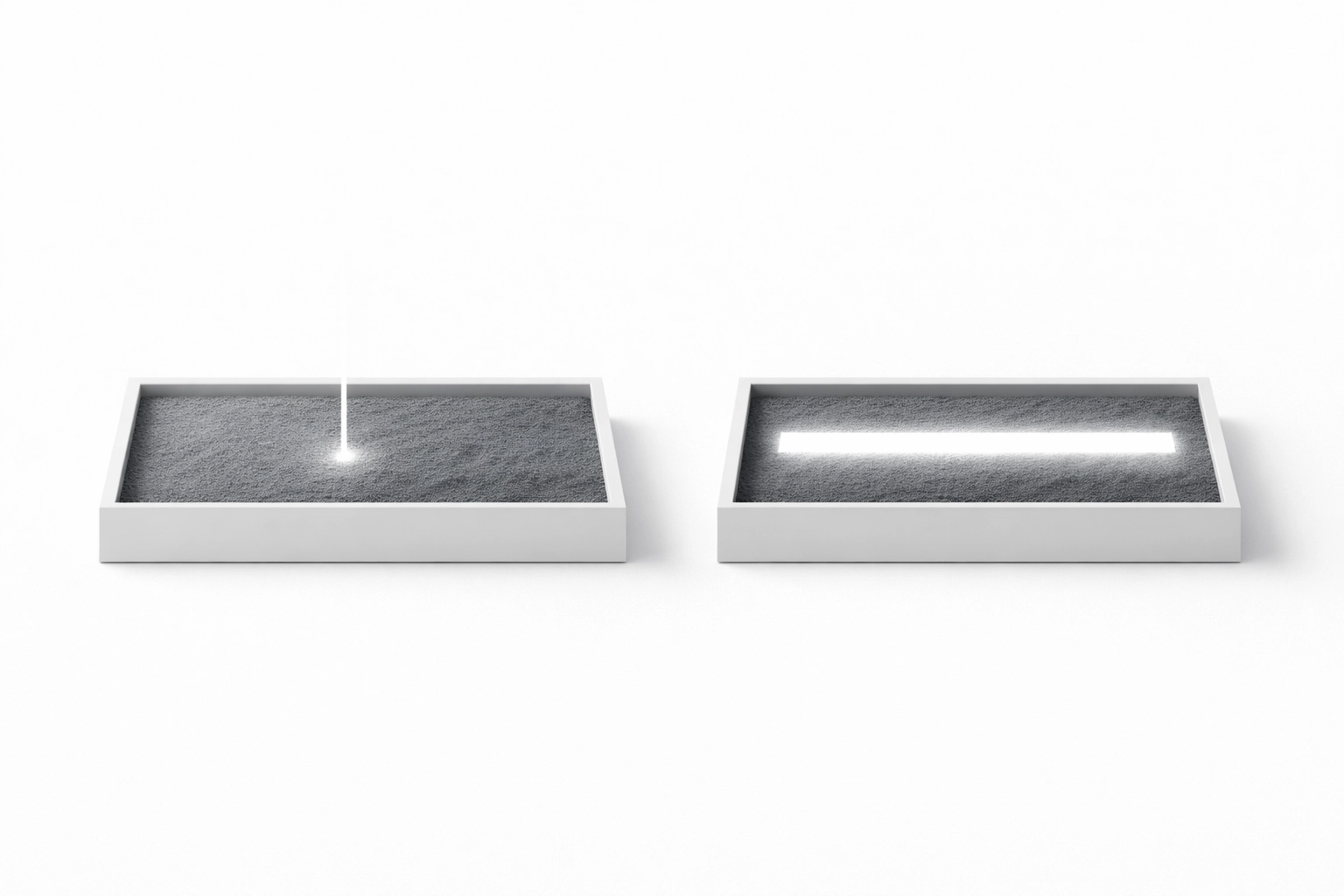
It uses a high-powered CO2 laser to trace the cross-section of your part onto a bed of heated polymer powder. The laser hits the powder, fuses it together, and the bed drops down for the next layer. It’s precise, tried, and true.
MJF (Multi Jet Fusion) is the high-octane newcomer from HP.
Instead of a laser, it uses an inkjet array to apply a "fusing agent" onto the powder bed, followed by a "detailing agent" around the edges of the part. Then, massive heat lamps sweep across the bed, fusing the areas where the agent was applied.
1. Isotropy: The Engineer's Priority
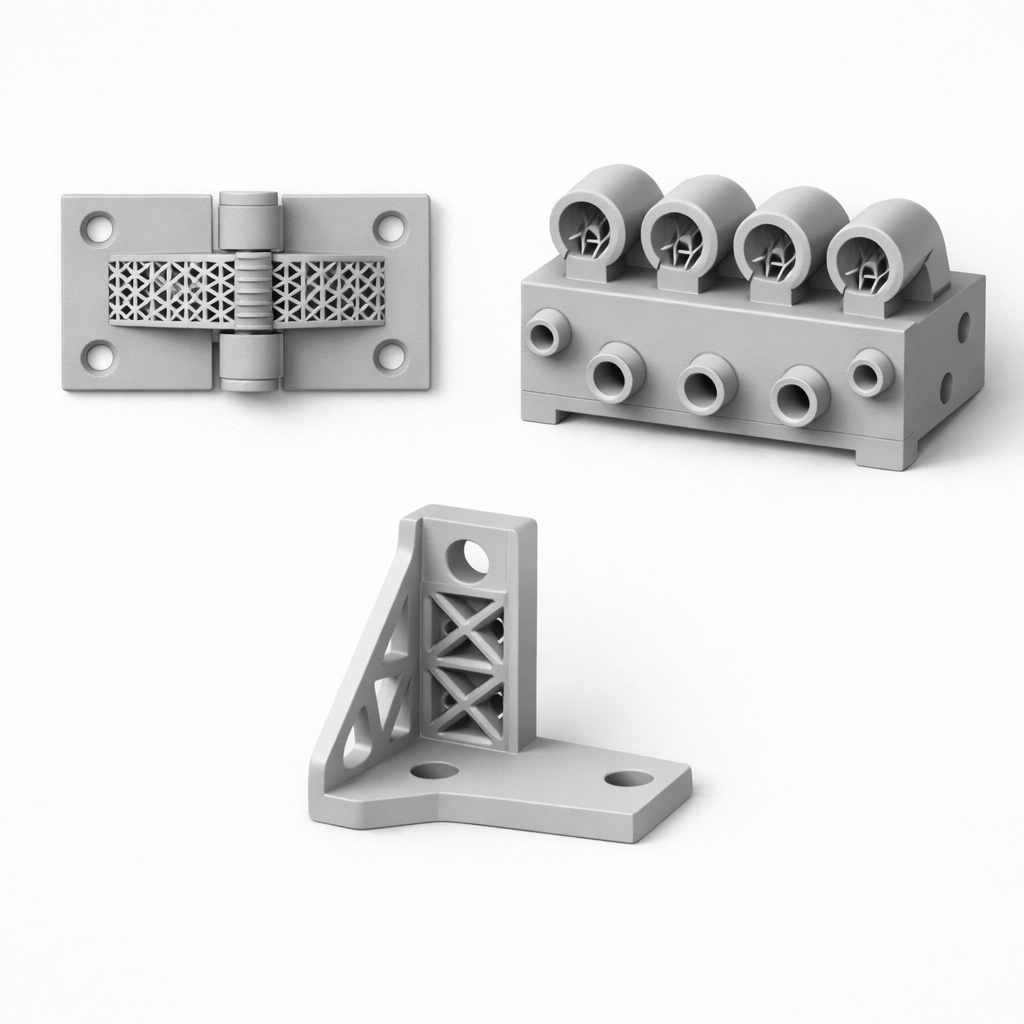
If you’re designing a functional bracket or a pressurized manifold, you care about strength. Specifically, you care if that strength is the same in every direction.
Traditional FDM (filament) printing is notoriously anisotropic: it’s much weaker in the Z-axis (between layers).
SLS is a significant step up. Because the laser sinters the powder in a heated chamber, the layers bond well. However, because the laser takes time to move, there can still be slight variations in mechanical properties depending on the orientation of the part. It’s "nearly" isotropic.
MJF takes the win here. Because the heat is applied uniformly across the entire layer at once by the lamps, the fusion is incredibly consistent. MJF parts are essentially isotropic. This means you don't have to stress as much about how the part is oriented in the build volume to ensure it won't fail under load. If you need uniform strength for complex functional parts, MJF is often the safer bet.
2. Surface Finish and Aesthetics
How does it feel in your hand? How does it look on the assembly?
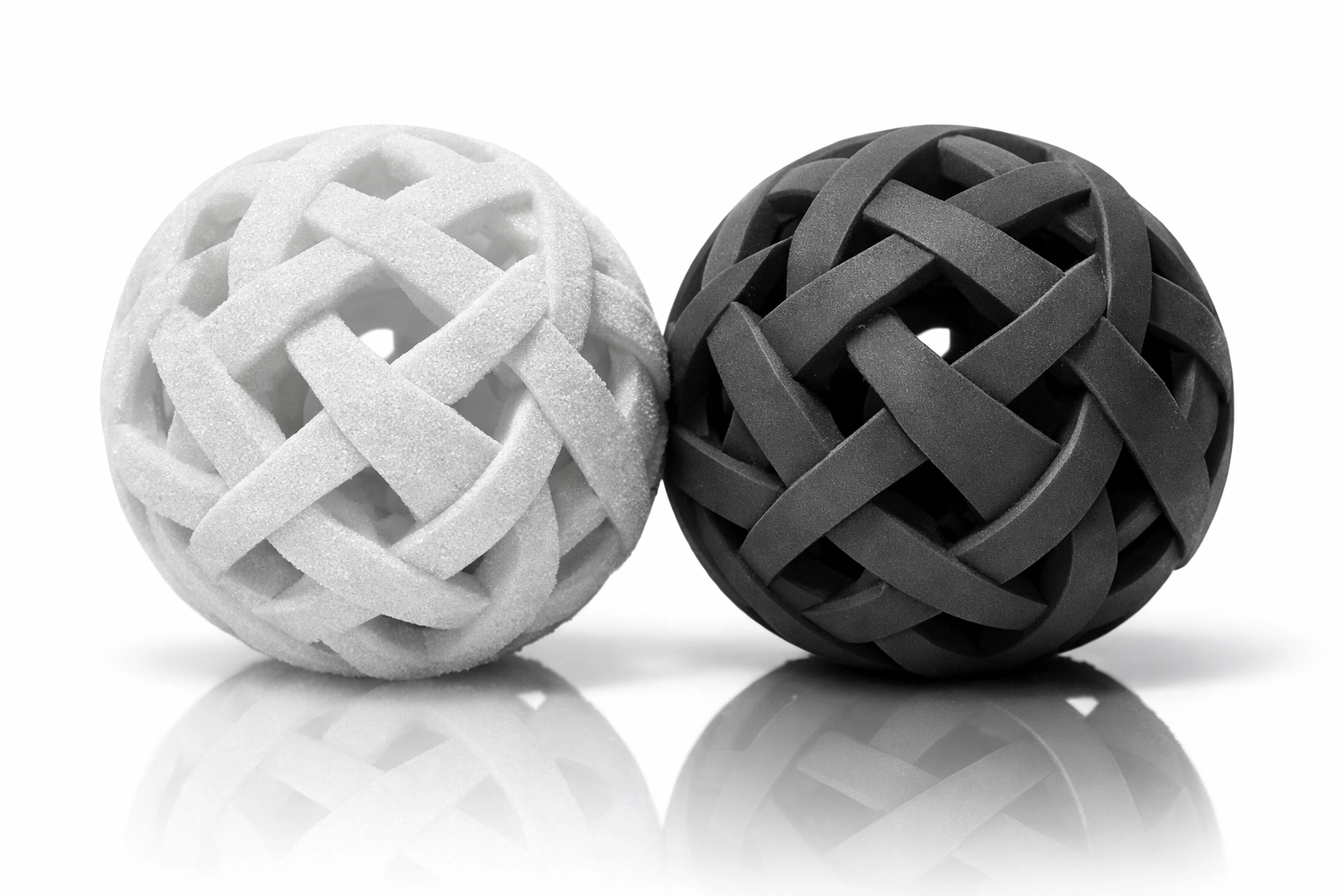
SLS parts typically come out of the machine with a grainy, "sugary" texture. The laser spot size (usually 0.3mm to 0.4mm) creates a slightly rougher surface. If you need a smooth finish, you’re looking at post-processing like bead blasting or media tumbling.
MJF offers a slightly smoother "out-of-the-box" finish. The 1200 DPI resolution of the inkjet heads allows for finer detail and sharper edges. However, there is a catch: color. MJF parts are almost always charcoal gray because the fusing agent is black to better absorb heat. If you want a different color, they are usually dyed black.
SLS parts are naturally white or off-white. This makes them much easier to dye into vibrant colors or leave as-is for a clean, medical-look finish.
3. Dimensional Accuracy and Fine Features
When we talk about Additive Manufacturing, tolerances are everything.
Both technologies are excellent for complex geometries that would be impossible to machine or mold. But if you have tiny, intricate features: think living hinges or small interlocking gears: MJF usually has the edge. The detailing agent used in the MJF process helps define edges more crisply by preventing heat from "bleeding" into the surrounding powder.
That said, for very large parts (over 100mm), SLS can sometimes offer slightly better dimensional stability (.03% vs MJF’s .05% in some materials). If you’re working on a massive enclosure where a half-millimeter matters, we should look closely at the SLS specs.
4. Speed and Lead Times
Time is the one resource no engineer has enough of.
If you need one or two prototypes, SLS is often faster to set up and get running. But if you are looking at "Bridge Production": moving from prototype toward mid-volume: MJF is the clear leader.
Because MJF fuses entire layers at once rather than tracing them with a laser, it doesn't care how complex or "full" the build plate is. A build plate with 100 parts takes nearly the same amount of time to fuse as a build plate with 10 parts. Combine that with faster cooling cycles, and MJF becomes the powerhouse for small-to-medium batches.
At SICAM, we optimize these lead times by matching your volume to the right machine capacity. You can see how this affects your specific project by heading over to our Online Quote tool.
5. Material Versatility
What are we making this out of?
Both SLS and MJF lean heavily on Nylon (PA 12 and PA 11). These are the workhorses of the industry: strong, chemical-resistant, and durable.
However, SLS has been around longer, which means the material catalog is wider. If you need specialized materials like carbon-filled nylon (for high rigidity) or fire-retardant materials, SLS usually offers more "off-the-shelf" options.
MJF is catching up fast, with excellent PA 12, PA 11, and flexible TPU options, but the range is still slightly narrower than the SLS ecosystem.
The Decision Matrix: Which One Should You Choose?
 Still on the fence? Here is the "Tech-Forward Mentor" cheat sheet for your next project.
Choose SLS If:
- You need specific materials: Carbon-filled, glass-filled, or flame-retardant polymers.
- You need white parts: Or you need to dye parts a specific light color.
- You have very large, voluminous parts: SLS handles large, thick cross-sections with a bit more grace.
Choose MJF If:
- Isotropy is critical: You need the part to be equally strong in X, Y, and Z axes.
- Fine details are key: You have small features, sharp edges, or thin walls.
- You’re scaling up: You need 50, 100, or 500 units and you need them yesterday.
- Surface quality matters: You want a smoother finish with less post-processing.
Beyond the Print: The SICAM Way
Choosing the technology is only half the battle. The other half is execution. At SICAM, we don't just "hit print." We look at your CAD file and evaluate how orientation, nesting, and cooling will affect your functional performance.
Whether you're looking for 3D Printing Services or you're trying to figure out how to transition from a prototype to a Solution, we're here to guide the process.
Functional parts aren't just about the machine; they're about the engineering intent behind them. MJF and SLS are both incredible technologies: now you just have to pick the right one for the job.
Final Thought for the Design Engineer
Don't get paralyzed by the tech. The beauty of modern manufacturing is that you can test both. Print a functional prototype in SLS, then run a bridge production batch in MJF. The data will tell you what your design needs.
We’re ready when you are. Let’s build something that works!
341